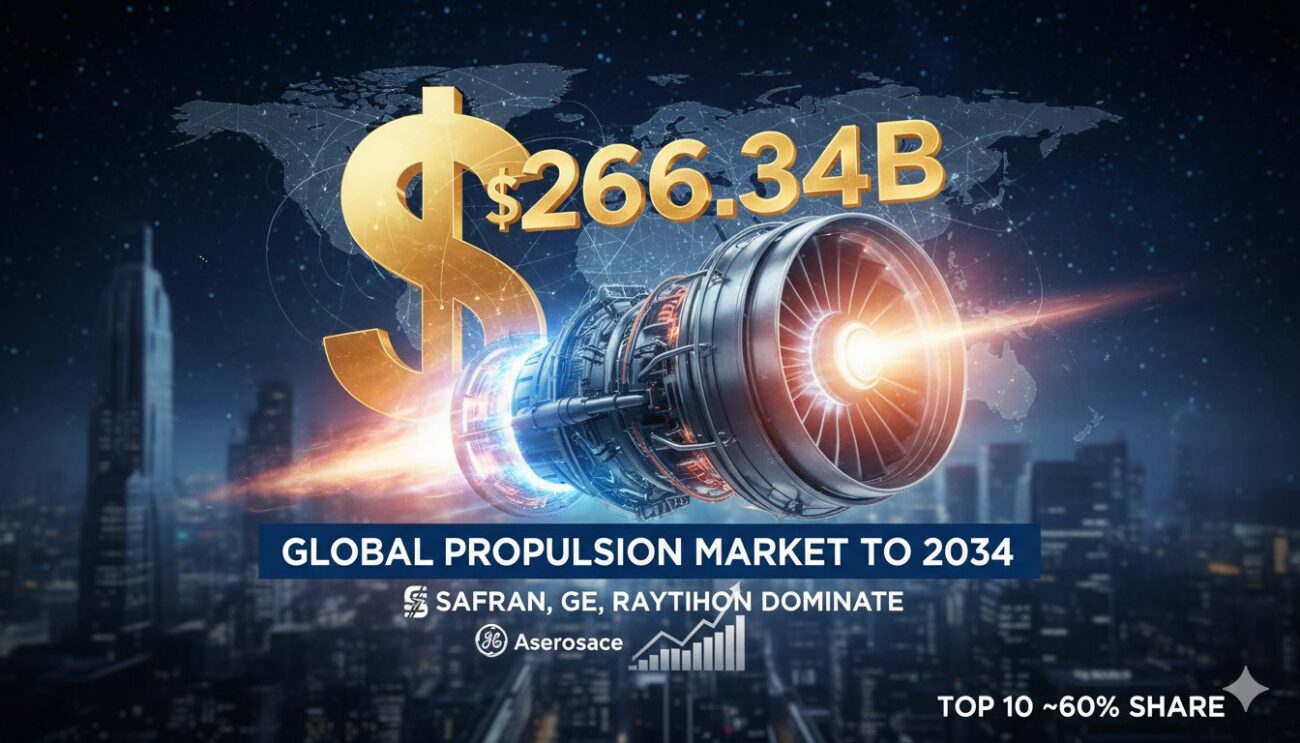
“The global propulsion systems market is projected to hit $266.34 billion by 2034, fueled by surging demand in aerospace, defense, and space sectors. Dominant players like Safran, GE Aerospace, CFM International, and Raytheon control significant shares, with the top ten companies holding about 60.2% of the market. Key opportunities lie in electric vertical takeoff and landing vehicles, advanced missiles, and unmanned aerial vehicles, while strategies focus on sustainable technologies and regional growth in Asia Pacific and North America.”
Market Dynamics and Growth Projections
The propulsion systems sector encompasses a wide array of technologies powering aircraft, missiles, spacecraft, and unmanned vehicles. Current market valuation stands at approximately $143.84 billion, with steady expansion driven by heightened global defense budgets, commercial aviation recovery, and space exploration initiatives. Projections indicate a compound annual growth rate of around 7.4% through 2030, accelerating slightly thereafter to achieve the $266.34 billion milestone by 2034.
This growth trajectory reflects robust investments in next-generation systems, including air-breathing engines for commercial jets and non-air-breathing variants for space applications. Defense spending, particularly in the U.S., has escalated, bolstering demand for high-performance missile and UAV propulsion. Commercial aviation’s push for fuel efficiency amid rising fuel costs further amplifies market momentum.
Dominant Players and Competitive Landscape
| Year | Market Size (USD Billion) | CAGR (%) |
|---|---|---|
| 2025 | 143.84 | – |
| 2026 | 155.13 | 7.8 |
| 2030 | 206.51 | 7.4 (average from 2025-2030) |
| 2034 | 266.34 | 6.6 (average from 2030-2034) |
The market is highly consolidated, with the top ten companies commanding roughly 60.2% of global share. Safran leads in innovative engine designs, particularly for civil aviation and military applications. GE Aerospace, through its standalone operations and joint ventures, excels in high-thrust turbofans and sustainable fuel adaptations. CFM International, a collaboration between GE Aerospace and Safran, dominates narrow-body aircraft propulsion with engines known for reliability and efficiency. Raytheon, part of a larger defense conglomerate, specializes in missile and UAV systems, leveraging advanced materials for superior performance.
Other notable players include Rolls-Royce, Pratt & Whitney, Honeywell, and IHI Corporation, each contributing specialized expertise. This oligopolistic structure fosters intense R&D competition, resulting in breakthroughs like hybrid-electric systems and additive-manufactured components.
Safran : Focuses on eco-friendly propulsion, with investments in hydrogen and electric technologies exceeding 15% of annual revenue.
GE Aerospace / CFM International : Commands over 40% of the commercial aviation segment, emphasizing digital twins for predictive maintenance.
Raytheon : Drives defense innovations, capturing 25% of the missile propulsion subcategory through hypersonic advancements.
Opportunities in Emerging Technologies
Significant opportunities arise from the boom in electric vertical takeoff and landing (eVTOL) systems, projected to add $15-20 billion to the market by 2034. Urban air mobility demands compact, efficient propulsion, attracting startups and established firms alike. Long-range missiles, spurred by geopolitical tensions, represent another growth avenue, with U.S. defense contracts alone valued at over $50 billion annually.
Unmanned aerial vehicles (UAVs) are expanding rapidly, with military and commercial applications driving a 12% CAGR in this subsegment. Sustainable fuels and electric propulsion for small satellites further open doors, as governments prioritize green initiatives. The shift toward reusable launch vehicles could reduce costs by 30%, enhancing accessibility for commercial space ventures.
Strategic Approaches for Market Expansion
Companies are adopting multifaceted strategies to capitalize on these opportunities. Emphasis on R&D for hydrogen propulsion systems addresses environmental regulations, with prototypes demonstrating 20% emissions reductions. Partnerships, such as joint ventures in electric and hybrid tech, accelerate development timelines.
Supply chain resilience is a priority, with investments in domestic manufacturing to mitigate disruptions. Digital simulation and AI-driven testing cut development costs by up to 25%, enabling faster market entry. Expansion into Asia Pacific, where aviation demand is surging, involves localized production and collaborations with regional giants.
In the defense realm, strategies include modular designs for quick upgrades and integration with autonomous systems. For commercial applications, focus on aftermarket services generates recurring revenue, often comprising 40% of total earnings.
Regional Insights and Sector Breakdown
North America holds the largest share at over 40%, bolstered by U.S. leadership in defense and space. The region’s ecosystem, including NASA collaborations and private ventures, fuels innovation. Europe follows with 25%, driven by stringent emissions standards and strong aerospace hubs in France and the UK.
Asia Pacific is the fastest-growing region, expected to achieve a 9% CAGR, thanks to China’s space ambitions and India’s aviation boom. South America and the Middle East offer niche opportunities in oil-related defense and emerging commercial fleets.
By application:
Aircraft: 50% market share, dominated by turbofans.
Missiles: 20%, with hypersonic tech gaining traction.
UAVs: 15%, expanding in surveillance and delivery.
Spacecraft: 15%, focused on electric and chemical systems.
Challenges and Risk Mitigation
Supply chain vulnerabilities, particularly in rare earth materials, pose risks, but diversification strategies are in play. Regulatory hurdles for new technologies require proactive compliance efforts. Economic fluctuations impact commercial demand, yet defense stability provides a buffer.
Investments in workforce training address labor shortages, ensuring sustained innovation. Cybersecurity integration protects advanced digital systems from threats.
Disclaimer: This article is for informational purposes only and does not constitute financial advice, investment recommendations, or endorsements. All information is based on publicly available data and industry reports.
