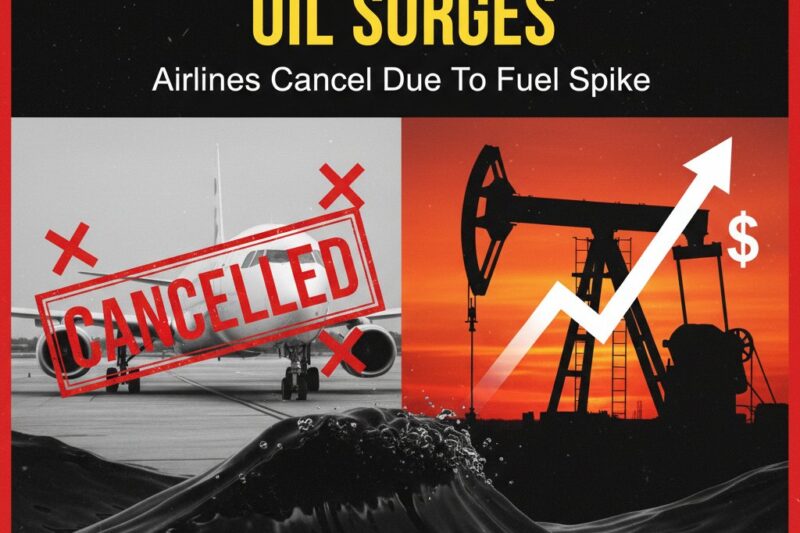
The surge in global oil prices, driven by escalating geopolitical tensions in the Middle East including the ongoing conflict involving Iran, has begun to force airlines worldwide to cancel flights and adjust operations. Brent crude has climbed to around $112 per barrel, with WTI near $98, pushing jet fuel costs dramatically higher—often doubling in short periods. Carriers like Air New Zealand have canceled over 1,100 flights through early May, impacting tens of thousands of passengers, while Scandinavian Airlines (SAS) announced cancellations of around 1,000 flights in April alone. Additional airlines are trimming schedules, imposing surcharges, or raising fares to cope with fuel expenses that now threaten profitability. U.S. travelers face potential ripple effects through higher ticket prices and reduced capacity on international routes, as the industry grapples with one of its most severe fuel-related crises in recent years.
Posted in

The surge in global oil prices, driven by escalating geopolitical tensions in the Middle East including the ongoing conflict involving Iran, has begun to force airlines worldwide to cancel flights and adjust operations. Brent crude has climbed to around $112 per barrel, with WTI near $98, pushing jet fuel costs dramatically higher—often doubling in short periods. Carriers like Air New Zealand have canceled over 1,100 flights through early May, impacting tens of thousands of passengers, while Scandinavian Airlines (SAS) announced cancellations of around 1,000 flights in April alone. Additional airlines are trimming schedules, imposing surcharges, or raising fares to cope with fuel expenses that now threaten profitability. U.S. travelers face potential ripple effects through higher ticket prices and reduced capacity on international routes, as the industry grapples with one of its most severe fuel-related crises in recent years.

“Airlines are responding to skyrocketing jet fuel costs triggered by Middle East instability, with major carriers … The surge in global oil prices, driven by escalating geopolitical tensions in the Middle East including the ongoing conflict involving Iran, has begun to force airlines worldwide to cancel flights and adjust operations. Brent crude has climbed to around $112 per barrel, with WTI near $98, pushing jet fuel costs dramatically higher—often doubling in short periods. Carriers like Air New Zealand have canceled over 1,100 flights through early May, impacting tens of thousands of passengers, while Scandinavian Airlines (SAS) announced cancellations of around 1,000 flights in April alone. Additional airlines are trimming schedules, imposing surcharges, or raising fares to cope with fuel expenses that now threaten profitability. U.S. travelers face potential ripple effects through higher ticket prices and reduced capacity on international routes, as the industry grapples with one of its most severe fuel-related crises in recent years.Read more

Netflix stock is currently trading around $95 , far from the $200 mark that some investors might still hope for after its historical peaks. The question of whether NFLX can reach $200 remains a hot topic among market watchers, but based on current fundamentals, analyst consensus, and recent performance, the path looks challenging in the near to medium term.
Posted in

Netflix stock is currently trading around $95 , far from the $200 mark that some investors might still hope for after its historical peaks. The question of whether NFLX can reach $200 remains a hot topic among market watchers, but based on current fundamentals, analyst consensus, and recent performance, the path looks challenging in the near to medium term.

**” Netflix shares have rebounded impressively in recent months with a strong monthly gain, yet they … Netflix stock is currently trading around $95 , far from the $200 mark that some investors might still hope for after its historical peaks. The question of whether NFLX can reach $200 remains a hot topic among market watchers, but based on current fundamentals, analyst consensus, and recent performance, the path looks challenging in the near to medium term.Read more