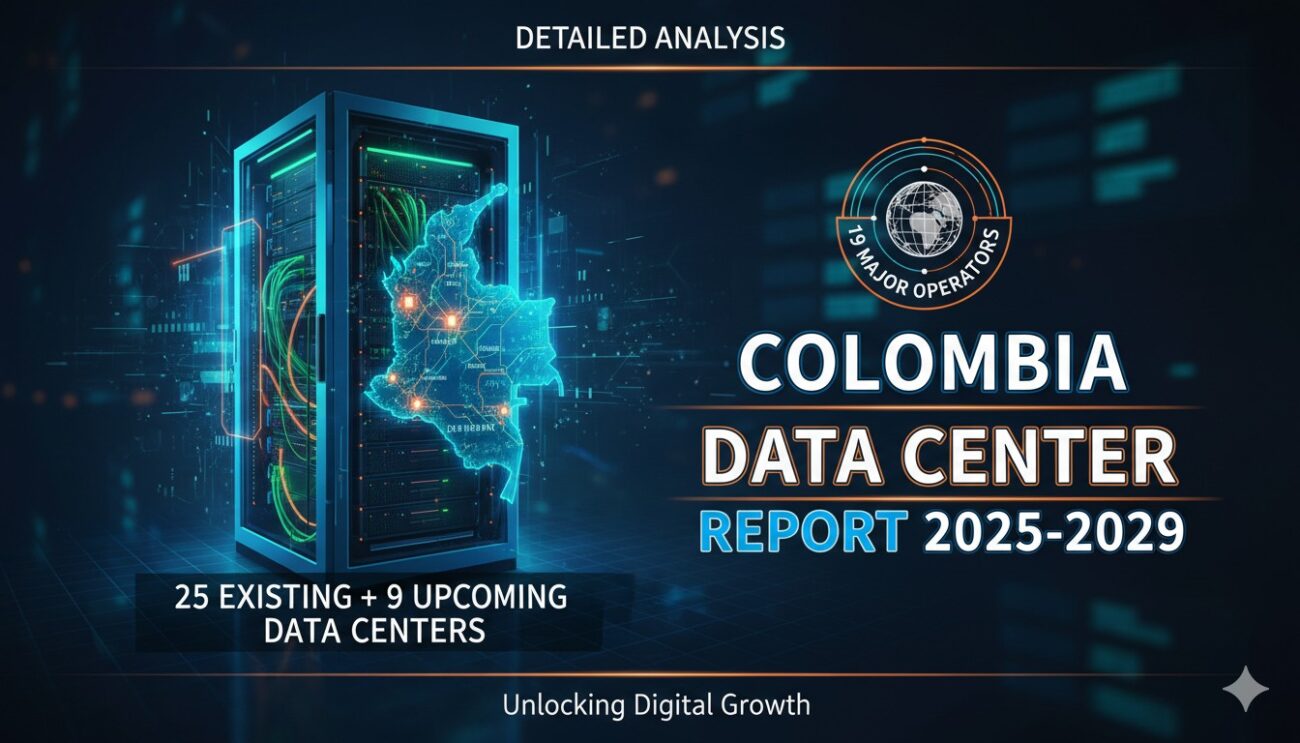
“Colombia’s colocation data center market is poised for explosive growth through 2029, with 25 operational facilities currently concentrated in key cities like Bogota and nine new builds adding over 200 MW in IT load capacity. Driven by 19 prominent operators and investors, the sector eyes fourfold expansion in white-floor space amid rising digital demands and global connectivity enhancements.”
Colombia Colocation Data Center Portfolio 2025-2029
Colombia’s colocation landscape features a robust network of 25 existing facilities, predominantly in Bogota which holds over 95% of the rack capacity, supplemented by sites in Barranquilla, Cali, and Medellin. These centers support a baseline IT load capacity that sets the stage for rapid scaling, with design standards ranging from Tier I to IV and emphasizing power and cooling redundancy to ensure uptime for enterprise and hyperscale clients.
Existing Data Centers Breakdown
The current portfolio prioritizes Bogota as the epicenter, where high-density operations cater to financial services, cloud providers, and e-commerce giants. Facilities vary in size, with core and shell areas averaging tens of thousands of square feet per site, and IT load capacities per center ranging from 1 MW to over 20 MW in larger hubs. Rack capacities collectively exceed thousands, supporting diverse workloads from edge computing to big data analytics.
Upcoming Data Centers Outlook
| City | Number of Facilities | Key Characteristics |
|---|---|---|
| Bogota | 20+ | High-tier redundancy, large-scale IT loads, proximity to financial districts |
| Barranquilla | 2 | Coastal access for connectivity, mid-tier designs |
| Cali | 2 | Regional focus on manufacturing support |
| Medellin | 1 | Emerging tech hub with sustainable features |
All nine planned developments target Bogota, underscoring its status as Colombia’s tech powerhouse. These projects, slated for completion between 2026 and 2029, will inject approximately 35 MW of new power capacity by late 2026, escalating to over 200 MW at full build-out—nearly quadrupling existing levels. Investments per facility span from tens to hundreds of millions, allocated across electrical (40%), mechanical (30%), and general construction (30%) infrastructures.
Key projections include white-floor space expansion exceeding four times current footprints, enabling advanced AI and IoT deployments. Project statuses range from under construction to announced, with leading builds focusing on modular designs for quick scalability.
Major Operators and Investors
Nineteen entities dominate the market, blending local telecom expertise with international capital. Leading in IT capacity are specialized firms offering wholesale and retail services, while others focus on niche expansions.
Ascenty (Digital Realty): Expands hyperscale capabilities.
Cirion Technologies (Lumen Technologies): Leverages fiber networks for low-latency colocation.
Claro: Integrates telecom infrastructure.
DHAmericas: Recent entrant with aggressive Bogota builds.
EdgeConneX: Edge-focused deployments.
EdgeUno: Regional connectivity specialist.
Equinix: Global interconnection hubs.
Etix Everywhere: Sustainable modular centers.
GlobeNet Telecom: Submarine cable integrations.
Grupo Gtd: Enterprise-grade services.
Grupo ZFB (Zetta Data Center): Local innovation leader.
HostDime: Cloud and hosting emphasis.
IPXON Networks: Network-neutral facilities.
KIO Networks: High-density wholesale options.
ODATA (Aligned Data Centers): Multi-billion investments in new campuses.
Scala Data Centers: Scalable AI-ready infrastructure.
Takoda (TIVIT): IT-managed services.
Tecto Data Centers (V.tal): Fiber-backed colocation.
Tigo: Mobile-driven data solutions.
Capacity and Growth Projections
By 2029, IT load capacity is forecast to surpass 200 MW, driven by a 17.5% CAGR in overall data center investments, pushing market value toward $1 billion. White-floor space will balloon to accommodate rising demands from smart city initiatives and international cloud migrations. Submarine cable enhancements—10 existing and three upcoming—bolster global bandwidth, reducing latency for U.S.-based enterprises eyeing Latin American expansion.
Pricing Dynamics
Retail colocation pricing remains competitive, with quarter racks starting at $200-300 monthly, half racks at $400-600, and full 42U cabinets ranging $800-1,200 depending on power density and add-ons like cross-connects. Wholesale rates per kW hover $100-150, influenced by long-term contracts and energy efficiency incentives. These figures reflect 2025 baselines, with modest upward pressure from inflation and supply chain factors.
Market Trends and Drivers
Sustainability emerges as a core theme, with operators adopting green cooling and renewable energy to meet ESG standards. Bogota’s development costs average $7 per watt, rising slightly due to global material shortages. The shift toward Tier III and IV certifications ensures resilience against outages, appealing to finance and tech sectors. Hyperscale demand from U.S. firms accelerates growth, positioning Colombia as a strategic bridge between North and South America.
Disclaimer: This news report offers general tips and insights derived from various sources; it is not financial advice and readers should conduct independent verification.
