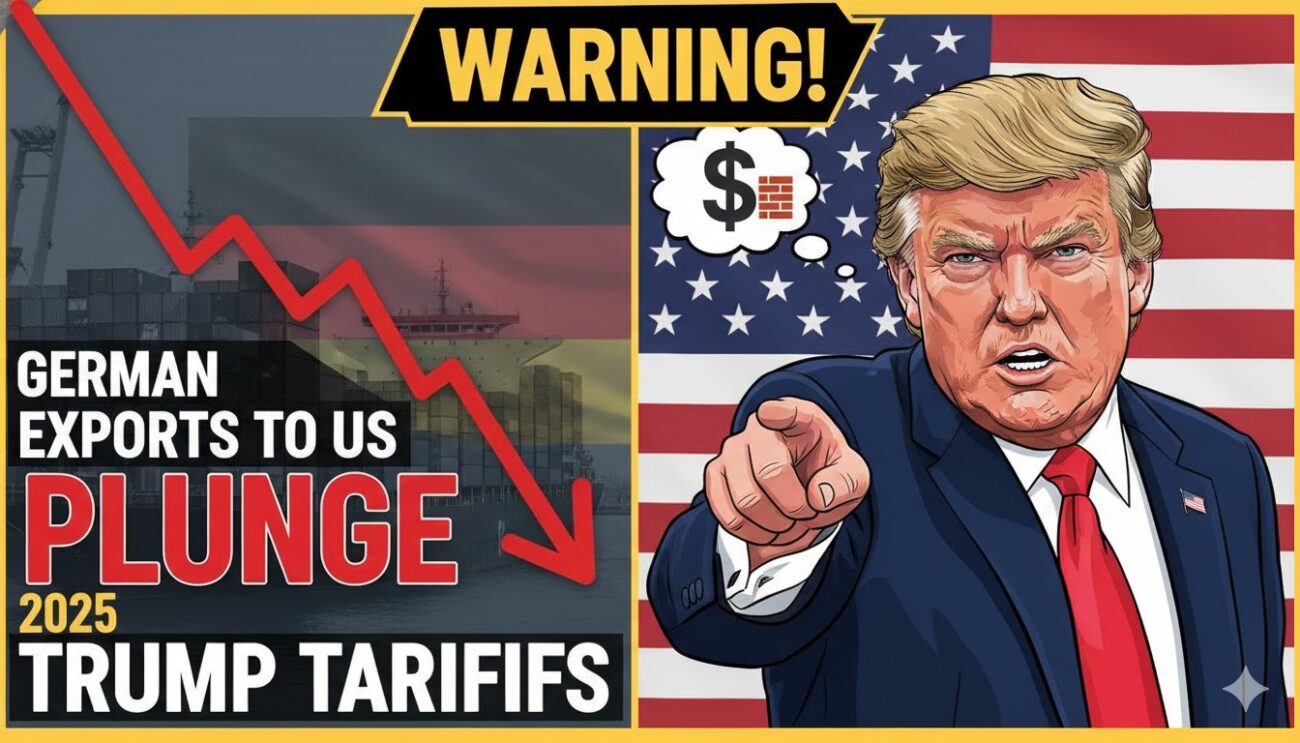
German exports to the United States experienced a sharp decline throughout 2025, falling by 9.4% in the first 11 months to €135.8 billion, primarily driven by tariffs imposed by the Trump administration. Key sectors like automotive and machinery were hit hardest, with drops of 17.5% and 9% respectively, while overall trade weakened amid higher costs and uncertainty, contributing to Germany’s modest 0.2% economic growth for the year.
The downturn in German shipments to the American market marked a significant reversal from prior years of steady growth, as tariffs averaging 15% on most goods and up to 50% on steel and aluminum products disrupted supply chains and raised costs for U.S. importers. This led to reduced demand for high-value German products, exacerbating pressures on Europe’s largest economy and highlighting vulnerabilities in transatlantic trade relations. The overall value of German goods exported to the U.S. totaled €135.8 billion through November, a 9.4% drop from the same period in 2024, according to official statistics. When viewed through U.S. trade data, imports from Germany reached $127.3 billion for the full year, reflecting a bilateral deficit of $58.3 billion, down from previous highs.
Monthly breakdowns reveal the progressive impact, with exports contracting more severely in the latter half of the year following the full implementation of tariff measures in August. For instance, U.S. imports from Germany fell from a peak of $16.5 billion in March to lows around $11.1 billion in August, before a partial rebound. The cumulative effect translated to an 8.6% decline from February to October compared to the prior year, the steepest non-pandemic drop since 2010.
Sector-Specific Declines
The automotive industry, a cornerstone of German manufacturing, bore the brunt of the tariffs. Exports of cars and vehicle parts plummeted 17.5% to €26.9 billion in the first 11 months, with year-over-year drops reaching 19% in key periods. This sector, which accounts for roughly 20% of German exports to the U.S., faced heightened competition from domestic American producers and Asian alternatives, as the 15% levy made models from brands like BMW, Mercedes-Benz, and Volkswagen less competitive in the U.S. market. Production adjustments in German plants led to reduced output, with ripple effects on suppliers of components such as engines and chassis.
Machinery exports, another vital category, decreased by 9% to €24 billion, affected by the 50% duties on steel and aluminum-intensive products. This included industrial equipment like turbines, pumps, and precision tools, where U.S. buyers shifted to tariff-exempt sources. Chemical products saw a similar 10% contraction, while pharmaceuticals bucked the trend with a modest 0.7% increase to €26.2 billion, buoyed by demand for specialized drugs unaffected by the broader tariff regime.
A table illustrating the key sectoral changes:
Broader Economic Ramifications
| Sector | 2025 Export Value (€ billion) | Change from 2024 (%) |
|---|---|---|
| Automotive (Cars & Parts) | 26.9 | -17.5 |
| Machinery | 24.0 | -9.0 |
| Pharmaceuticals | 26.2 | +0.7 |
| Chemicals | Not specified (overall down) | -10.0 |
| Total Exports | 135.8 (Jan-Nov) | -9.4 |
Beyond direct trade losses, the tariff-induced plunge strained German firms’ investments in the U.S., which nearly halved to around €10.2 billion from February to November, a 45% drop from the previous year’s €19 billion. Companies cited not only the duties but also dollar depreciation and policy unpredictability as factors deterring expansion. This pullback affected job creation and technology transfers, with German multinationals redirecting capital to markets like China and Mexico, where trade barriers were lower.
The export slump contributed to Germany’s anemic 0.2% GDP growth in 2025, as external demand weakened. With exports comprising nearly half of the nation’s economic output, the U.S. market’s role—absorbing about 10% of total German shipments—amplified the impact. Rolling 12-month trade surpluses with the U.S. shrank from over €70 billion to under €58 billion, representing a 17% contraction that shaved approximately 0.3% off GDP. Industrial sectors reported sharper declines: autos and parts alone accounted for nearly half of the global export drop in those categories, while machinery’s worldwide shipments fell 3.3% due to U.S. losses.
Key points on the economic fallout:
Manufacturing Strain : German factories, particularly in Bavaria and Baden-Württemberg, saw output reductions, with automotive production down double digits. This led to layoffs and shorter workweeks, echoing challenges from prior global slowdowns.
Supply Chain Disruptions : Tariffs on intermediate goods like metals increased costs for U.S.-based assembly, prompting some German firms to localize production but at higher upfront expenses.
Diversification Efforts : In response, German exporters pivoted to Asia and emerging markets, but gains there (e.g., a rebound in China trade) failed to fully offset U.S. losses, resulting in a net drag on overall exports, which rose just 0.9% globally to €1.44 trillion.
Currency and Cost Factors : A stronger euro relative to the dollar compounded the issue, making German goods 5-7% more expensive for American buyers on top of tariffs.
Policy and Market Responses
U.S. tariff policies, framed as reciprocal measures to address trade imbalances, included exemptions for certain pharmaceuticals but imposed broad levies that effectively taxed American importers. This shifted the burden downstream, with U.S. households facing higher prices for imported vehicles and equipment—estimated at an additional $2,400 annually per family. German officials and business groups described the situation as a “new normal,” with no quick reversal expected, urging diversification and domestic stimulus to mitigate risks.
In the U.S., the tariffs aimed to bolster domestic manufacturing but yielded mixed results: while some sectors like energy exports to Europe surged under related deals, overall job gains were offset by losses in tariff-exposed industries. German firms, meanwhile, accelerated onshoring strategies, investing in U.S. facilities to bypass duties, though this came at the expense of European jobs.
A comparative table of U.S.-Germany trade balances:
Long-Term Outlook
| Year | U.S. Exports to Germany ($ billion) | U.S. Imports from Germany ($ billion) | Trade Deficit ($ billion) |
|---|---|---|---|
| 2024 | Not specified (prior trends) | Higher baseline | ~70 (in euros equivalent) |
| 2025 | 69.1 | 127.3 | -58.3 |
Projections indicate persistent headwinds, with German exports to the U.S. potentially stabilizing at 5-10% below pre-tariff levels, equating to annual losses of €8-15 billion. Sectors like autos face ongoing pressure from U.S. incentives for electric vehicles, where German models compete against subsidized American and Chinese alternatives. Broader transatlantic ties remain strained, with German dependence on U.S. markets underscoring the need for resilient supply chains and alternative partnerships.
Disclaimer: This article is for informational purposes only and does not constitute financial advice, investment recommendations, or endorsements. All data and opinions are based on publicly available information and should not be relied upon for decision-making without independent verification.
