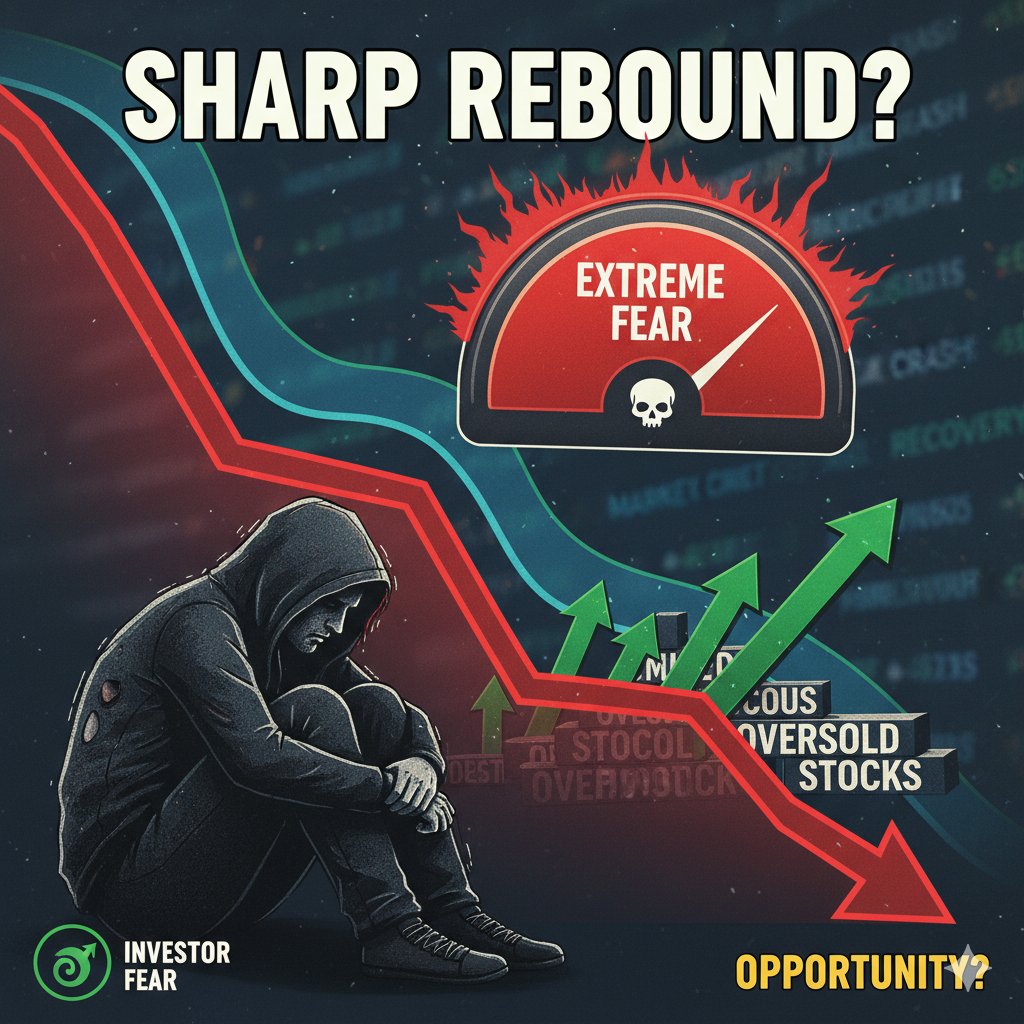
Investor sentiment has shifted to extreme fear, with the CNN Fear & Greed Index hitting 18—signaling widespread panic selling across equities. The S&P 500 has pulled back sharply from recent highs near 7,000 to levels around 6,500-6,600, reflecting broad-based declines driven by heightened volatility, safe-haven flows, and concerns over economic indicators. Historically, such extreme fear readings have often preceded strong rebounds, as oversold conditions create opportunities for mean reversion in fundamentally sound stocks. Several large-cap and sector names now flash deeply oversold technical signals, positioning them for potential sharp recoveries as sentiment stabilizes.
Investor Fear Just Got “Extreme.” These Oversold Stocks Might Be Due for a Sharp Rebound.
The stock market is in the grips of intense selling pressure, pushing the benchmark S&P 500 down significantly from its peaks earlier in the year. Broad indices have shed value rapidly, with the NASDAQ and Dow Jones also reflecting the strain. The VIX, often called the fear gauge, has spiked notably, underscoring elevated uncertainty. This environment has left many high-quality stocks trading at depressed levels, with technical indicators like the Relative Strength Index (RSI) dipping below 30—a classic oversold threshold that suggests exhaustion in selling and potential for a bounce.
Extreme fear readings on sentiment gauges like the Fear & Greed Index have historically acted as contrarian signals. When panic dominates, valuations compress, often setting the stage for attractive entry points for long-term investors. While no rebound is guaranteed, and downside risks remain from macroeconomic headwinds, the current setup highlights several oversold names across sectors that could deliver sharp upside if sentiment improves or positive catalysts emerge.
Here are some standout oversold stocks that stand out in the current environment:
Delta Air Lines (DAL) The airline sector has been hammered by concerns over travel demand softening and fuel cost volatility. Delta shares have fallen sharply this month, pushing the stock into deep value territory with an RSI well into oversold levels. Despite near-term pressures, the company’s strong balance sheet, premium revenue strategies, and loyal customer base provide a solid foundation. As economic fears ease, air travel could rebound faster than anticipated, potentially driving a quick recovery in the stock.
JPMorgan Chase (JPM) Big banks have faced headwinds from interest rate uncertainty and fears of slower loan growth. JPMorgan has seen its shares drop considerably, trading at levels that undervalue its diversified operations, leading market position, and consistent profitability. With an oversold RSI, the stock appears poised for a relief rally if credit conditions stabilize and net interest margins hold up better than expected.
Bank of America (BAC) Similar dynamics are at play for Bank of America, where shares have plunged amid broader financial sector weakness. The bank’s consumer and commercial banking franchises remain robust, and its exposure to higher-for-longer rates has been a double-edged sword. Oversold technicals suggest the selloff may be overdone, opening the door for a sharp rebound as investors rotate back into beaten-down financials.
Toyota Motor (TM) Auto stocks have suffered from supply chain echoes and demand worries in a higher-rate world. Toyota’s shares have retreated to oversold territory, despite the company’s unmatched global scale, hybrid leadership, and conservative financial management. As inventory levels normalize and consumer spending holds, the stock could see a meaningful snapback.
Unilever (UL) Consumer staples giant Unilever has not been immune to the broad risk-off move, with shares falling on margin concerns and slower growth fears. Yet its portfolio of essential brands provides defensive qualities, and the RSI signals deep oversold conditions. A stabilization in commodity costs and pricing power could catalyze a strong recovery.
These names represent a cross-section of sectors hit hard by the current downdraft—transportation, financials, autos, and consumer goods. Their oversold status is evident not just in RSI readings but also in compressed valuations relative to historical norms and earnings potential.
To illustrate the breadth of the opportunity, consider the following key technical and valuation snapshot (approximate recent levels):
| Stock | Recent Price Range | RSI (14-day) | Key Support Level | Forward P/E | Why Oversold Rebound Potential? |
|---|---|---|---|---|---|
| Delta Air Lines (DAL) | Mid-$40s to low-$50s | <30 | Recent lows | ~7-8x | Travel recovery catalyst |
| JPMorgan Chase (JPM) | High-$180s to low-$200s | Oversold | 200-day MA | ~10-11x | Banking sector rotation |
| Bank of America (BAC) | Mid-$30s | Deep oversold | Prior support | ~9-10x | Interest rate stabilization |
| Toyota (TM) | Around $180-200 | <30 | Technical floor | ~8x | Global auto demand rebound |
| Unilever (UL) | Mid-$50s | Oversold | Key levels | ~16-17x | Defensive earnings stability |
Investors should monitor for signs of capitulation bottoming, such as volume spikes on up days or improving breadth in market internals. While extreme fear can persist longer than expected, history shows that periods of maximum pessimism often mark the best buying opportunities. These oversold stocks, backed by strong fundamentals, could lead the charge in any mean-reversion rally.
Disclaimer: This is for informational purposes only and does not constitute investment advice, recommendations, or solicitation to buy or sell securities. Always conduct your own research and consult with a financial advisor before making investment decisions.
