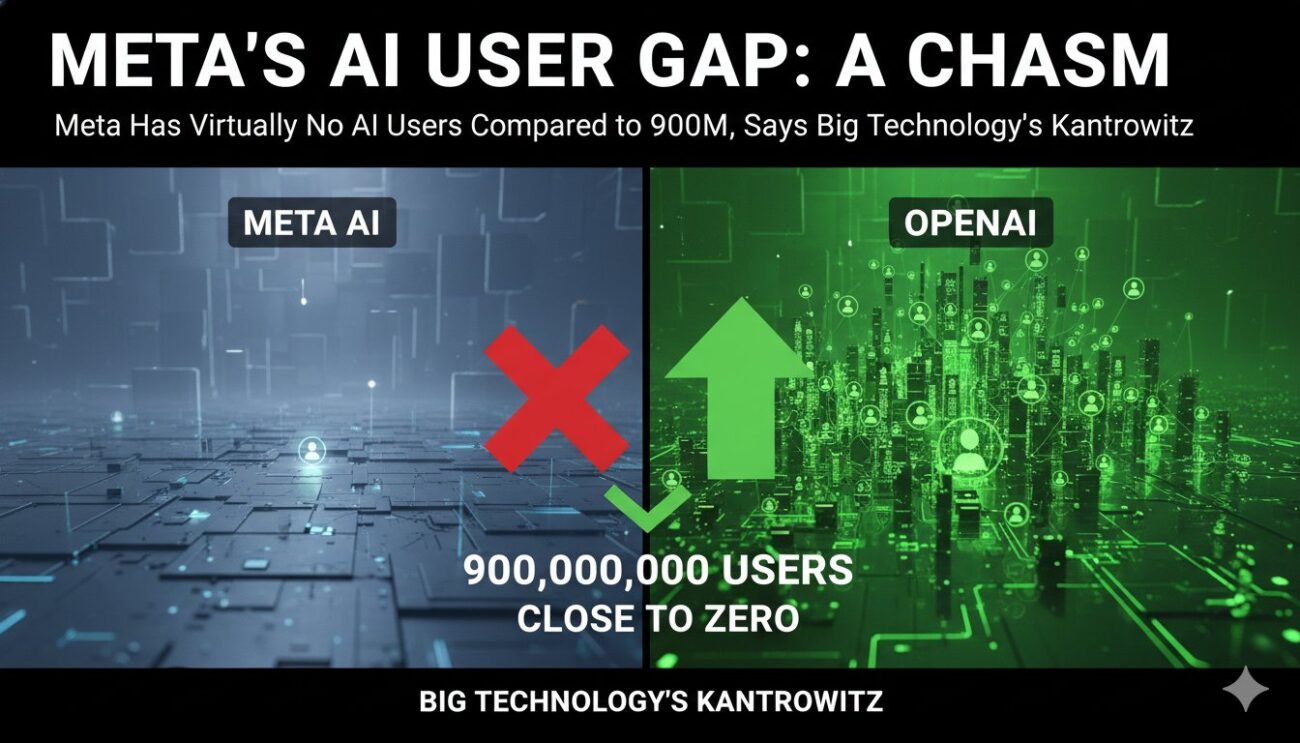
“Alex Kantrowitz of Big Technology has highlighted a stark contrast in the AI landscape: OpenAI’s ChatGPT boasts 900 million weekly active users, while Meta’s AI efforts attract virtually no dedicated, intentional users in comparison. This gap underscores Meta’s challenges in building a competitive standalone AI product despite its enormous social platforms and integrated AI features.”
Meta Lags Far Behind in Capturing Dedicated AI Engagement
The artificial intelligence race among tech giants has reached a critical juncture, with adoption metrics revealing a clear divide between leaders and challengers. OpenAI continues to dominate the consumer AI space through its flagship ChatGPT product, which has achieved an extraordinary scale. Recent announcements confirm that ChatGPT now commands 900 million weekly active users, a figure that positions it as the go-to entry point for generative AI interactions worldwide. This milestone reflects rapid growth, building on earlier reports of 800 million weekly users just months prior, and accompanies strong monetization with over 50 million paying consumer subscribers.
In sharp contrast, Meta Platforms faces significant hurdles in translating its vast social ecosystem into meaningful AI user engagement. While Meta has integrated its AI assistant across Facebook, Instagram, WhatsApp, and Messenger—reaching massive audiences through passive exposure—the company struggles to foster “intentional” usage. Intentional users are those who actively seek out and interact with AI tools as primary destinations, rather than encountering them incidentally while scrolling feeds or messaging friends.
Industry observers point to this distinction as pivotal. Meta’s AI, powered by its Llama family of open-source models, benefits from broad distribution thanks to the parent company’s nearly 4 billion monthly active users across its family of apps. Yet, the assistant often serves auxiliary roles—suggesting replies, generating images, or answering quick queries embedded in social contexts—rather than driving standalone sessions. This integration strategy has enabled Meta to report over 1 billion monthly active users interacting with Meta AI in some capacity, but these numbers largely reflect opportunistic touchpoints rather than committed, habitual usage.
The critique from Alex Kantrowitz, founder of Big Technology and a seasoned tech commentator, crystallizes the issue. He emphasizes that OpenAI’s 900 million weekly active users represent people deliberately choosing ChatGPT for tasks ranging from practical guidance and information retrieval to creative writing and coding assistance. In comparison, Meta lacks a comparable base of users who prioritize its AI offerings independently. This disparity raises questions about Meta’s ability to compete in the foundational AI model arena, where user preference and direct engagement drive innovation cycles, data feedback loops, and revenue potential.
Several factors contribute to Meta’s position. First, OpenAI pioneered the consumer chatbot experience with ChatGPT’s launch, establishing brand dominance and user habits early. The product’s simplicity, reliability, and continuous improvements have created strong network effects. Meanwhile, Meta has pursued an open-source approach with Llama models, aiming to democratize AI and embed it ubiquitously across its platforms. While this has accelerated developer adoption and lowered barriers for third-party integrations, it has not yet translated into a killer consumer-facing AI application that rivals ChatGPT’s pull.
Internal challenges at Meta further complicate the picture. Reports indicate delays in releasing advanced models, with internal benchmarks showing them trailing competitors from OpenAI, Google, and Anthropic. This has prompted discussions about potentially licensing external technologies, such as Google’s Gemini, to bridge gaps—a move that would mark a strategic pivot from self-reliance. Meta’s heavy investments in AI talent and infrastructure, including billions in capital expenditures for data centers, demonstrate commitment, but the returns in user adoption remain elusive.
Key Comparison of AI User Metrics
OpenAI/ChatGPT :
900 million weekly active users
Over 50 million paying consumer subscribers
Primary use cases: Practical guidance, information seeking, writing, coding
Meta AI :
Over 1 billion monthly active interactions (integrated across apps)
Largely passive or contextual usage
Limited evidence of standalone, intentional daily engagement
This table highlights the qualitative difference: scale through integration versus depth through preference. OpenAI’s model thrives on direct competition for user attention in the AI space, while Meta leverages its social moat but risks commoditizing its AI as a feature rather than a destination.
Broader implications extend to the competitive dynamics of the AI sector. If intentional usage correlates with monetization potential—through subscriptions, enterprise tools, or advertising—OpenAI’s lead could widen its financial advantage. Meta’s strategy of embedding AI everywhere may yield long-term benefits by enhancing platform stickiness and creating new revenue streams in social commerce or content creation. However, without a breakout standalone product, the company may continue facing scrutiny over its AI return on investment.
The race remains fluid, with emerging players and evolving user behaviors. Yet the current snapshot, as underscored by recent commentary, shows OpenAI firmly in command of consumer AI mindshare, while Meta grapples with converting its distribution strength into genuine AI loyalty.
Disclaimer: This is a news and analysis report based on publicly discussed industry developments and metrics. It is for informational purposes only and not investment advice.
