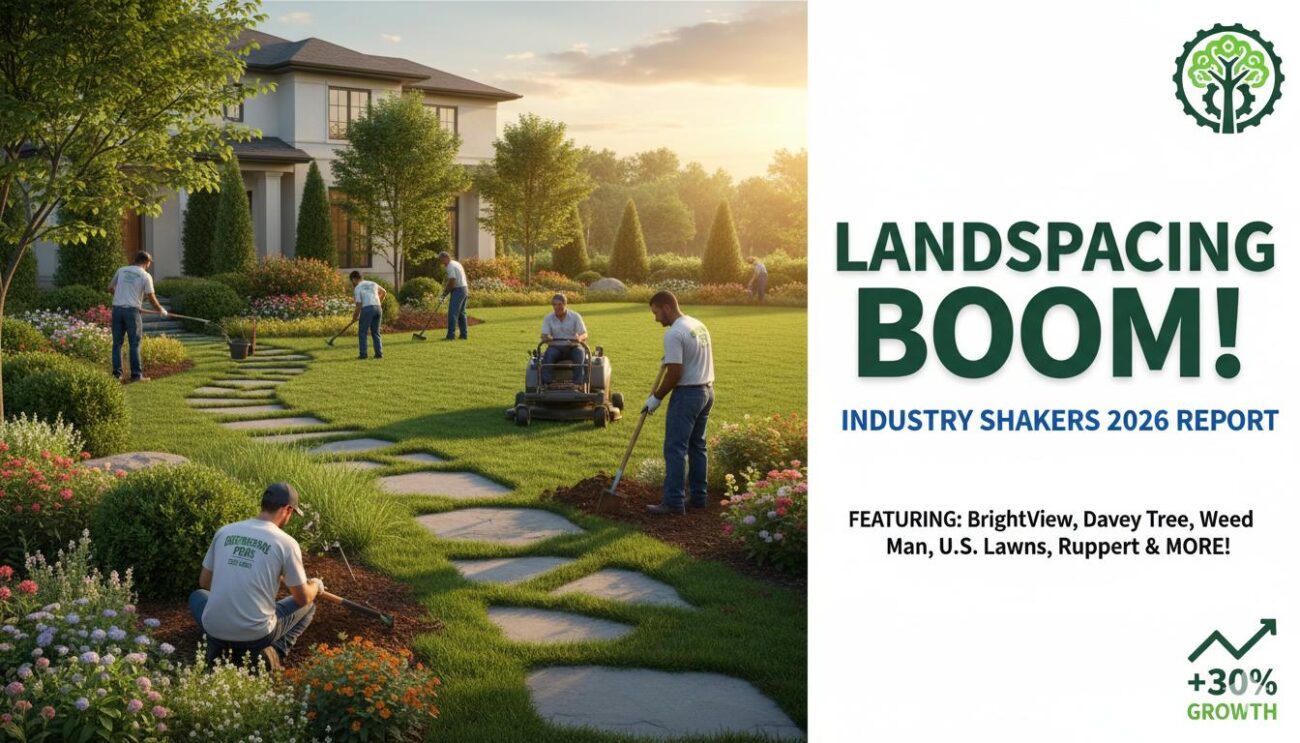
The U.S. landscaping services market is poised for continued growth in 2026, supported by rising investments in sustainable practices, urban greening initiatives, and outdoor enhancements. Despite persistent labor challenges, leading firms are advancing through technology adoption, eco-friendly solutions, and strategic expansions, with the sector benefiting from heightened demand in commercial properties and residential upgrades.
U.S. Landscaping Services Market Outlook for 2026
The U.S. landscaping industry maintains its position as a vital component of property management and environmental enhancement. Recent data points to a market size of around $188.8 billion in 2025, reflecting a compound annual growth rate of about 6.5% over the prior five years through steady increases in service demand. Forecasts for 2026 suggest mild to moderate expansion, with revenue potentially approaching or exceeding $196 billion in some estimates, fueled by a combination of residential spending on outdoor living areas, commercial site improvements, and public sector beautification efforts.
Growth drivers include the push toward climate-resilient designs, such as drought-tolerant plantings and efficient irrigation, alongside broader urbanization trends that prioritize green infrastructure. Commercial landscaping, which often involves large-scale maintenance contracts for office parks, retail centers, and institutional properties, continues to dominate revenue contributions. Residential services, including lawn care and garden enhancements, benefit from homeowners seeking professional solutions for curb appeal and leisure spaces. Municipal projects, driven by community revitalization and environmental goals, add further stability.
Challenges persist, particularly around labor availability. The industry employs over 1.4 million workers across hundreds of thousands of businesses, yet shortages of skilled crews remain a top concern, pushing wages higher and prompting greater reliance on automation and retention strategies. Seasonal fluctuations, material cost pressures from potential tariffs, and regulatory scrutiny on water and chemical use also shape operations.
Leading Players and Their Strategic Positioning
BrightView Holdings stands out as one of the largest providers, particularly in commercial landscaping. The company operates a national network delivering maintenance and development services. Recent performance shows net service revenues in the low $600 million range for recent quarters, with full-year guidance projecting total revenue between $2.67 billion and $2.73 billion for fiscal 2026, alongside expectations for margin improvement through operational efficiencies. BrightView’s integrated model allows it to serve diverse clients, from corporate campuses to educational institutions, while emphasizing route-based maintenance for recurring revenue stability.
The Davey Tree Expert Company focuses heavily on tree care and related arborist services, complementing broader landscaping needs. With revenues recently reported around $1.84 billion, the firm benefits from specialized expertise in tree preservation, risk management, and utility vegetation management. This niche positions it well amid growing emphasis on mature tree health in urban and suburban settings, where climate impacts heighten the need for professional intervention.
Weed Man USA operates primarily through a franchise model, delivering lawn care and weed control services across numerous territories. System-wide sales have reached over $387 million in recent periods, supported by consistent double-digit growth in units and revenue. The brand’s focus on targeted treatments and customer retention through subscription-style programs aligns with homeowner demand for hassle-free, eco-conscious lawn maintenance. Expansion efforts, including new franchise openings and territory growth, underscore its scalability in the residential segment.
U.S. Lawns maintains a strong presence in commercial grounds maintenance, serving properties such as office complexes, retail outlets, and HOAs with comprehensive mowing, edging, and enhancement services. Its franchise-based structure enables localized delivery while benefiting from national branding and operational support, allowing it to compete effectively in high-volume, recurring contract work.
Ruppert Landscape specializes in high-end commercial and institutional projects, often involving design-build elements alongside ongoing maintenance. The firm’s reputation for quality execution in complex environments, such as corporate headquarters and healthcare facilities, supports premium pricing and long-term client relationships. Its emphasis on sustainable practices, including native plant integration and water-efficient systems, resonates with clients pursuing environmental objectives.
Market Trends Shaping 2026 Performance
Sustainability emerges as a defining theme. Providers increasingly incorporate native and drought-resistant plants, permeable hardscapes, and smart irrigation technologies to reduce water consumption and chemical reliance. These adaptations not only address environmental regulations but also appeal to clients prioritizing ESG considerations.
Technology integration accelerates efficiency gains. Robotic mowers, AI-driven scheduling, and sensor-based irrigation help mitigate labor constraints while improving service precision. Firms investing in these tools report better productivity and cost management.
The ongoing labor shortage drives innovation in workforce strategies. Companies enhance recruitment through competitive wages, training programs, and benefits, while exploring automation to reduce dependency on manual labor.
Consolidation activity remains active, with private equity interest targeting regional operators for scale advantages in purchasing, technology, and geographic coverage.
Sector Segmentation and Opportunities
Maintenance services, encompassing mowing, trimming, fertilization, and weed control, capture the largest share due to their recurring nature. Design and construction segments grow faster in certain forecasts, driven by new developments and renovations emphasizing outdoor features like patios, water elements, and multifunctional spaces.
Commercial end-users lead in volume, but residential growth accelerates with rising disposable income and interest in personalized landscapes. Municipal demand supports steady baseline activity through public parks and streetscape improvements.
Landscaping Services Market Key Metrics (U.S. Focus)
2025 Market Size : Approximately $188.8 billion
Projected 2026 Growth : Mild to moderate, potentially 4-6% in core estimates
Employment : Over 1.4 million workers
Businesses : Around 693,000 entities
Average Customer Revenue (Benchmark) : $14,682 per customer
Employee Productivity (Benchmark) : $123 per employee hour
The sector’s fragmentation offers opportunities for both established leaders and nimble regional players. As demand for professional, sustainable landscaping persists, 2026 promises continued evolution toward more resilient, tech-enabled, and environmentally attuned services.
Disclaimer : This is a news and analysis report based on industry observations and publicly available data. It is for informational purposes only and does not constitute financial, investment, or professional advice.
