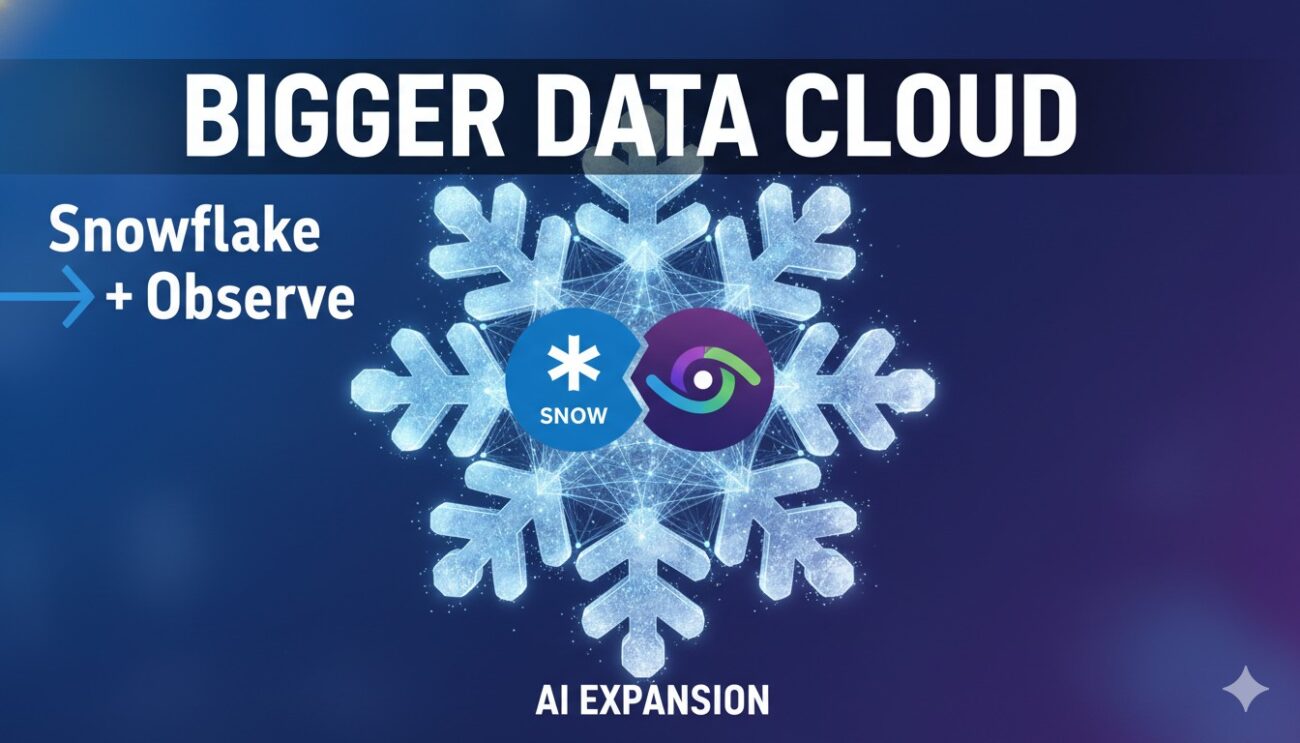
Snowflake has agreed to acquire observability leader Observe in a $1 billion deal to integrate AI-powered troubleshooting into its data platform, targeting faster issue resolution for complex AI agents and expanding into the multibillion-dollar IT operations market while facing competition from established players like Datadog.
Strategic Expansion in AI Observability
Snowflake’s push into advanced observability comes as enterprises grapple with the surge in telemetry data from AI-driven systems. The acquisition of Observe, a platform specializing in correlating logs, metrics, and traces through an AI-assisted site reliability engineer, positions Snowflake to offer unified data management that eliminates silos between observability and core data workflows. This integration leverages open standards like Apache Iceberg and OpenTelemetry, enabling enterprises to handle vast data volumes without resorting to costly sampling or limited retention periods.
By embedding Observe’s capabilities directly into its AI Data Cloud, Snowflake aims to empower developers and operations teams with real-time context for incident investigation. Enterprises can expect up to tenfold improvements in resolving production issues, shifting from reactive monitoring to proactive AI-driven insights. This is particularly critical as AI agents proliferate, generating exponential data that demands reliable oversight to maintain business operations.
Financial Implications and Market Positioning
The $1 billion price tag represents a significant premium, underscoring Snowflake’s aggressive strategy in the AI space. This move catapults the company into direct competition with observability giants, potentially disrupting vendors reliant on proprietary backends. Snowflake’s platform advantage lies in owning the data plane, allowing seamless AI execution and long-term value extraction from telemetry.
Stock performance reflects investor optimism, with shares trading around $210, marking a modest uptick amid broader market volatility. Analysts view this as a step toward capturing a slice of the over $50 billion IT operations management software market, where AI reliability is becoming a boardroom priority.
Key Benefits for Enterprises
Scalability for AI Workloads : Observe’s AI SRE tool correlates disparate data sources, providing unified graphs that accelerate root-cause analysis in complex environments.
Cost Efficiency : By avoiding data duplication and leveraging Snowflake’s economics, enterprises can manage petabyte-scale telemetry without ballooning expenses.
Developer-Friendly Integration : Built natively on Snowflake’s infrastructure, the combined offering simplifies workflows for teams building AI applications.
Enhanced Reliability : Proactive alerts and automated troubleshooting reduce downtime, ensuring AI agents operate with enterprise-grade stability.
Recent Acquisition Trajectory
Snowflake’s acquisition spree highlights its focus on bolstering AI capabilities:
| Acquisition | Focus Area | Value (Approximate) | Strategic Impact |
|---|---|---|---|
| Observe | AI Observability | $1B | Integrates telemetry for AI agent reliability |
| Crunchy Data | PostgreSQL Management | Undisclosed | Enhances database interoperability for data pipelines |
| Datavolo | Data Integration | Undisclosed | Streamlines multi-cloud data flows for AI |
| TruEra AI | AI Model Monitoring | Undisclosed | Improves governance and explainability in AI deployments |
This pattern signals Snowflake’s intent to create a comprehensive ecosystem where data, AI, and operations converge seamlessly.
Competitive Landscape
In a crowded field, Snowflake differentiates through its data-centric approach. Rivals like Datadog and Dynatrace offer robust tools but often require separate storage, leading to fragmentation. Snowflake’s strategy bets on consolidation, where observability becomes an inherent data function rather than a bolted-on service. This could pressure incumbents to rethink their architectures as enterprises prioritize unified platforms for AI scalability.
Disclaimer: This article is for informational purposes only and does not constitute investment advice, financial recommendations, or an endorsement of any securities. Readers should conduct their own research and consult qualified professionals before making any decisions.
